We all know that a good person can be a bad artist.
But no one will ever be a genuine artist
unless a great human being and thus also a good one.

Marc Chagall

Imagination is everything. It is the preview of life's coming attractions.
Imagination embraces the entire world,
and everything there will be to know and understand.
Imagination points to all we might yet discover and create.

Albert Einstein

Be who you are and say what you feel because those who mind don't matter
and those who matter don't mind.

I ♥! Dr. Seuss

The future belongs to those who believe in the beauty of their dreams.
Eleanor Roosevelt


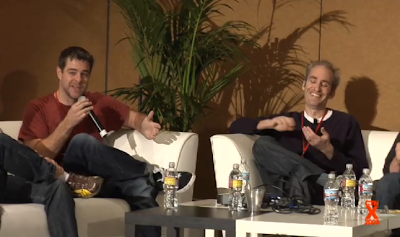
Chade-Meng Tan: Everyday Compassion as Google Business Strategy

“Compassion leads to happiness, compassion is fun. What if compassion is also profitable? What if compassion is good for business?

“Google is a company born of idealism. Expressions of corporate compassion start with a small group of Googlers, and they don’t usually ask for permission, then they get bigger and bigger until they become official.”

“Compassion creates highly effective business leaders: “I feel for you, I understand you, I want to help you.”

“Leaders highly ambitious for the greater good feel no need to inflate their own egos. Understanding, empathy, tones down the excesses of our own ego — creating leaders able to focus on a project rather than themselves.”

“Compassion also inspires co-workers and promotes collaboration, initiative, and creativity. “It makes us a highly effective company.”

“What is the secret formula for brewing compassion in a corporate setting? There are three ingredients:

“First, create a culture of compassionate concern for the greater good — how is your company, and your job serving the greater good? This awareness of serving a greater good is very self-inspiring, and, it creates fertile grounds for compassion to grow in.”

“The second ingredient is autonomy. “Google is a place where the inmates run the asylum.” If you already have a culture of compassion and idealism, and, you let your people run free? They will do the right thing.”

“The third ingredient is to focus on inner development and personal growth: self-awareness, self-mastery, empathy, and compassion. Leadership begins with character: attention training to create a calm, clear quality of mind as a foundation for emotional intelligence; developing self-knowledge and self-mastery as a high-resolution third-person perspective on one’s own thoughts; create new mental habits…your first impulse upon meeting someone: “I want you to be happy…I want you to be happy,” creating trust and compassion within the workplace.”

“If you want others to be happy, practice compassion; if you want to be happy, practice compassion.”

http://www.ted.com/talks/chade_meng_tan_everyday_compassion_at_google.html

Role Model to Superheroes: Rabia Basri (Rābiʻa al-ʻAdawiyya al-Qaysiyya رابعة العدوية القيسية ) Original Sufi Celebrant of ‘Divine Love’

 
All 
of what
I would want my child to know
my poems attempt.
 
We are infants before each other, are we not,
so vulnerable to each other’s words and 
movements.
 
A school I sat in cured me of hurting others.
 
I have come to see that all are seated at God’s table, 
and I have become God’s
servant.
 
Sometimes God is too shy to speak in public
and so God
pinches me.
 
That 
is my cue —
to fill in the blanks of your
understanding
 
the best I 
can.
(Rabia lived from 717 to 801 in Basra, Iraq)
 
 
Since no one really knows anything about God,
those who think they do are just
troublemakers.
 
She is without a doubt the most popular and influential of female Islamic saints and a central figure in the Sufi tradition.  Having been born nearly 500 years before Rumi, she, more than any other poet, influenced his writings.  Reading Rabia is like reading Rumi or Hafez – in the original.


Power of Art: Dice Tsutsumi Created A Benefit Fund “Artists Help Japan”

On March 11, an 8.9 earthquake struck off the northeast coast of Japan near the city of Sendai. It is the most powerful earthquake they ever experienced. Artists Help Japan Earthquake & Tsunami Fund is responding to the immediate needs of survivors as well as short-term to long-term recovery projects undertaken by the affected communities.

From their FAQ:

*Artists have done many successful fund raising auctions such as Totoro Forest Project and Art Blocks for Ghana.   Are you planning another art auction to raise money for this?

YES!  We believe there are things artists can do! We are in the process of setting up something like that.
This time, we may have to be more creative and ask each artist to step up to do more than just creating artwork.   We will keep you posted.  Please keep your eye on this blog.

*Where does this money go?

Artists Help Japan fund will go directly to Give2Asia’s main Japan Earthquake Fund.
Artists Help Japan is created as a simple portal to get artists united to help.  We have worked with Give2Asia and we believe they will use the fund wisely for what’s most needed in Japan.

http://artistshelpjapan.blogspot.com

http://give2asia.org/artistshelp


日本からいつもブログを観てくれてる方々へ。海のむこうから、なにもできる事がなく心痛い思いでニュースを見続けております。出来る事は本当に小さく、少ないですが、私たちも何かできないかと思い、アーティスト仲間で支援金を集めたいと思います。 皆さんや皆さんのご家族のご無事を心からお祈りしております。

Role Model to Superheroes: Pablo Neruda (Neftalí Ricardo Reyes Basoalto), Poet of Hope, Love, and Humanity

Neruda occupied many diplomatic posts and served a stint as a senator for the Chilean Communist Party. When conservative Chilean President González Videla outlawed communism in Chile in 1948, a warrant was issued for Neruda’s arrest. Friends hid him for months in a house basement in the Chilean port of Valparaíso before he escaped into exile through a mountain pass near Maihue Lake to Argentina.

Years later, Neruda was a close collaborator to socialist President Salvador Allende. When Neruda returned to Chile after his Nobel Prize acceptance speech, Allende invited him to read at the Estadio Nacional before 70,000 people. Chilean dictator Augusto Pinochet denied permission to transform Neruda’s funeral into a public event. However, hundreds of thousands of grieving Chileans disobeyed the curfew and crowded the streets of Santiago.

Colombian novelist Gabriel García Márquez called Neruda “the greatest poet of the 20th century in any language.” Neruda always wrote in green ink, “the color of hope.”

 
Every Day You Play
 
Every day you play with the light of the universe.
Subtle visitor, you arrive in the flower and the water.
You are more than this white head that I hold tightly
as a cluster of fruit, every day, between my hands.
 
You are like nobody since I love you.
Let me spread you out among yellow garlands.
Who writes your name in letters of smoke among the stars of the south?
Oh let me remember you as you were before you existed.
 
Suddenly the wind howls and bangs at my shut window.
The sky is a net crammed with shadowy fish.
Here all the winds let go sooner or later, all of them.
The rain takes off her clothes.
 
The birds go by, fleeing.
The wind. The wind.
I can contend only against the power of men.
The storm whirls dark leaves
and turns loose all the boats that were moored last night to the sky.
 
You are here. Oh, you do not run away.
You will answer me to the last cry.
Cling to me as though you were frightened.
Even so, at one time a strange shadow ran through your eyes.
 
Now, now too, little one, you bring me honeysuckle,
and even your breasts smell of it.
While the sad wind goes slaughtering butterflies
I love you, and my happiness bites the plum of your mouth.
 
How you must have suffered getting accustomed to me,
my savage, solitary soul, my name that sends them all running.
So many times we have seen the morning star burn, kissing our eyes,
and over our heads the gray light unwind in turning fans.
 
My words rained over you, stroking you.
A long time I have loved the sunned mother-of-pearl of your body.
I go so far as to think that you own the universe.
I will bring you happy flowers from the mountains, bluebells,
dark hazels, and rustic baskets of kisses.
I want to do with you what spring does with cherry trees.

Exceptional Storyboarding Tutorial by Louie del Carmen (and ‘Incremental Save’ Script for Photoshop and Bridge Workflow)

(previz from Louie del Carmen’s tutorial)
 

Digital artists are generous: community forums for sharing tips in our evolving medium have become small industries. Whether for Flash, Photoshop, or Maya — or whatever the next program will be — all of us are ultimately self-taught; each of us has our own techniques and workflows — those who share, nurture our community and profit from feedback in turn.

Story Artists are generous but with such a complex workflow it can be difficult to ask the right questions. Boards included in “Art of” books accompanying the release of films often only highlight polished “Hallmark” shots; novice storyboards are notoriously overwrought. (For an informative discussion on production vs polished boards watch this video.)

Louie del Carmen’s comprehensive storyboarding tutorial changes the discussion. From script to sequence viewers are lead through production quality boarding in a straightforward, accessible manner. If you have been scouring the internet for tips this tutorial is a treasure.

Louie’s tutorial will pay for itself within minutes if you are not yet using Adobe Bridge. $25 is a gift…wish more Story Artists were as generous as: http://www.cgmwonline.com/Louie-Del-Carmen.html

__________

Here’s a Photoshop script which works well with a Bridge workflow. The cool thing is it makes accidentally over-writing sequential files difficult: as you continue working from a single authoring file activating this script saves filenames in increments of 10. (At the very least it will speed up your workflow by eliminating the need to hand edit filenames.)

Paste the code below into a new file in ExtendScript Toolkit (part of Photoshop’s installation found here: Applications/Utilities/Adobe Utilities/ExtendScript Toolkit CS4 or /Applications/Utilities/Adobe Utilities-CS5/ExtendScript Toolkit CS5), save it as a jsx-file into Photoshop’s Presets/Scripts-folder.

After restarting Photoshop the Script should be available under File > Scripts and can be assigned a Keyboard Shortcut, recorded into an Action, used in a Configurator-Panel, or started from the ExtendScript Toolkit itself.

Default installations of Photoshop leave the Keyboard Shortcut ctrl+command+shit+S unassigned. By assigning this or another shortcut key you can then map a button on your Cintique to activate the script.

// saves psd copies in rising four digit numbers appended to the authoring file’s name;
#target photoshop
if (app.documents.length > 0) {
// get properties;
var thedoc = app.activeDocument;
var docName = thedoc.name;
var basename = docName.match(/(.*)\.[^\.]+$/)[1];
var docPath = thedoc.path;
// psd options;
psdOpts = new PhotoshopSaveOptions();
psdOpts.embedColorProfile = true;
psdOpts.alphaChannels = false;
// change this to true if you want all the layers in the copy;
psdOpts.layers = true;     
psdOpts.spotColors = true;
// get neighboring  psdf iles;
var theFiles = retrievePSDFiles (Folder (docPath));
// collect numbers;
var theNumbers = new Array;
for (var m = 0; m < theFiles.length; m++) {
     if (theFiles[m].name.match(basename+”_”+”[0-9]{1,4}”+”.psd”)) {
          var thisNumber = Number(theFiles[m].name.slice(0, theFiles[m].name.length – 4).match(/\d{1,4}$/));
          theNumbers.push(thisNumber);
          }
     };
// get largest number;
if (theNumbers.length > 0) {
     var number = Number(theLargestNumber(theNumbers));
     var theNumber = bufferNumberWithZeros(number + 10, 4)
     }
else {
     var theNumber = “0010”
     };
// save copy;
thedoc.saveAs((new File(docPath+’/’+basename+”_”+theNumber+”.psd”)),psdOpts,true);
};
////////////////////////////////////
////////////////////////////////////
////////////////////////////////////
////// buffer number with zeros //////
function bufferNumberWithZeros (number, places) {
     var theNumberString = String(number);
     for (var o = 0; o < (places – String(number).length); o++) {
          theNumberString = String(“0” + theNumberString)
          };
     return theNumberString
     };
////// get from subfolders //////
function retrievePSDFiles (theFolder, theFiles) {
     if (!theFiles) {var theFiles = []};
     var theContent = theFolder.getFiles();
     for (var n = 0; n < theContent.length; n++) {
          var theObject = theContent[n];
          if (theObject.constructor.name == “Folder”) {
               theFiles = retrievePSDFiles(theObject, theFiles)
               };
          if (theObject.name.slice(-4) == “.psd”) {
               theFiles = theFiles.concat(theObject)
               }
          };
     return theFiles
     };
////// function to get the biggest number;
function theLargestNumber (numbersArray) {
     var x = new Array;
     x = x.concat(numbersArray);
     while (x.length > 1) {
          if (x[0] >= x[x.length-1]) {
               var a = x.pop()
               }
          else {
               var a = x.shift()
               }
          }
     return x
     };

Feedback welcome: [email protected] Twitter: @oceanbluesky

Role Model to Superheroes: Phil Ochs (Anti-Drug Ad Spot)

 
“Hi, this is Phil Ochs.  Ever since the assassination of John Kennedy things began to fall apart in this country. People started caring less for each other and thought less of themselves. Some tried to escape as we suffered through two reactionary administrations. The war in Vietnam and the use of hard drugs have taken many lives. Now the war is over but drugs continue their destruction. I believe it’s time to turn the corner. I think we can get America back if we get ourselves back — you don’t need drugs, you don’t need gurus. You only need to believe in yourself. Remember it only takes a small circle of friends to get back to a life based on reality — rather than escape.”


“Philip David Ochs (pronounced /ˈoʊks/) (December 19, 1940 – April 9, 1976) was an American protest singer (or, as he preferred, a topical singer) and songwriter who was known for his sharp wit, sardonic humor, earnest humanism, political activism, insightful and alliterative lyrics, and haunting voice. He wrote hundreds of songs in the 1960s and released eight albums in his lifetime.

Ochs performed at many political events, including anti-Vietnam War and civil rights rallies, student events, and organized labor events over the course of his career, in addition to many concert appearances at such venues as New York City’s Town Hall and Carnegie Hall. Politically, Ochs described himself as a “left social democrat” who became an “early revolutionary” after the protests at the 1968 Democratic National Convention in Chicago led to a police riot, which had a profound effect on his state of mind.”

Ted Mathot, Scott Morse, Bill Presing and Derek Thompson at CTN

(sketch by Rembrandt)
 
Derek Thompson: The willingness of a story artist to dispose of their work, of their thinking, is almost equally important as their ability to draw, really, really well. […] That’s where process comes into play. Most artists that I know enjoy looking at rough, unfinished work. For any of you who think we’re doing inked finished typed boards — that’s not what it is. It’s dirty, it’s roll up your sleeves — it’s wet works in the plumbing, it’s really gritty, type of work. “Get in late, get out early.”
 
Ted Mathot: I generally do all my posing last, so, I’ll go in and I’ll try to nail down each shot. And get my progression of shots going first. So I’ll have one drawing for each shot — then I’ll go back in and start plussing. 
 
Bill Pressing: I try to do a minimum of three boards for a shot. Cause a lot of times you can do whatever you’re thinking of doing in three. [Thompson: “A beginning, middle, end — an A, B, C — where you’re in, in the shot, what the middle substance is, then how you exit the shot.]
 
Scott Morse: It’s neat to see how the rule of three works. I’m kind of a nerd about patterns these days, fractal geometry — I love finding patterns in things. Obviously in film there’s a three act structure — because it works, not because it is a “rule” that we stick to because, you know….” “Be prepared to do it, then have it thrown out.” A lot of people ask, “What kind of style do you look for?” — and it’s like, “ok, that’s a big red flag that you just threw it in my face,” ’cause a style isn’t gonna come across in storyboarding. Your drawing style needs to be — not a style. It needs to be a thinking style. You need to be able to work, play, well with others.  [Mathot: You need to be adaptable in that you can draw like other artists around you. But you also have to be able to adapt to the other directors, because they all have styles too, and you need to be able to work with that.] 

Irwin Greenberg’s Artist Survival Kit

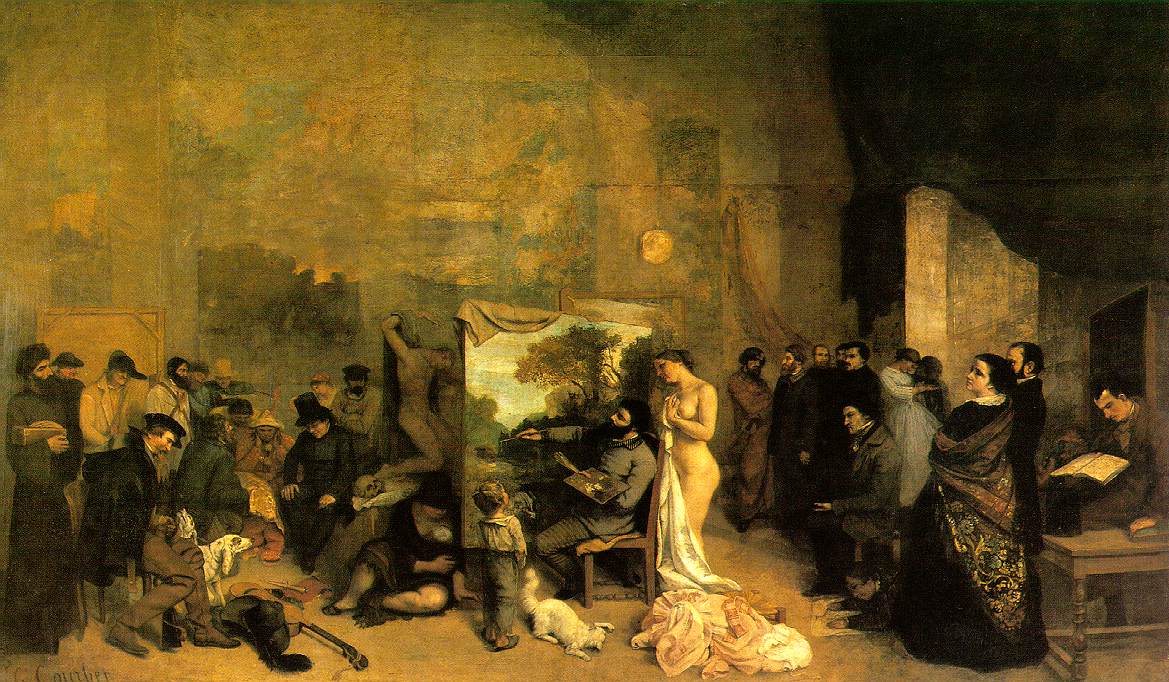
(Courbet, “The Painters Studio”)

1. Paint every day.
2. Paint until you feel physical strain- take a break and then paint some more.
3. Suggest.
4. When at an impasse, look at the work of masters.
5. Buy the best materials you can afford.
6. Let your enthusiasm show.
7. Find the way to support yourself.
8. Be your own toughest critic and best supporter.
9. Develop a sense of humor about yourself.
10. Develop the habit of work. Start early every day. When you take a break, don’t eat. Instead, drink a glass of water.
11. Don’t settle for yourself at your mediocre level.
12. Don’t allow yourself to be crushed by failure. Rembrandt had failures. Success grows from failure.
13. Be a brother (or sister) to all struggling artists.
14. Keep it simple.
15. Know your art equipment and take care of it.
16. Have a set of materials ready wherever you go.
17. Always be on time for work, for class, for an appointment.
18. Meet deadlines. Be better than your word.
19. Find a mate who is really a mate.
20. Don’t be envious of anyone who is more talented than you. Be the best you can.
21. Prizes are nice, but the real competition is with yesterday’s performance.
22. Give yourself room to fail and then fight like hell to achieve.
23. Go to sleep thinking about what you’re going to do first thing tomorrow.
24. Analyze the work of great painters. Study how they emphasize and subordinate.
25. Find out the fewest material things you need to live.
26. Remember: Michelangelo was once a helpless baby. Great works are the result of heroic struggle.
27. There are no worthwhile tricks in art: find the answer.
28. Throw yourself into each painting heart and soul.
29. Commit yourself to a life in art.
30. No struggle, no progress.
31. Do rather than don’t.
32. Don’t say “I haven’t the time.” You have as much time everyday as the great masters.
33. Read. Be conversant with the great ideas.
34. No matter what you do for a living, nurture your art.
35. Ask. Be hungry to learn.
36. You are always the student in a one-person art school. You are also the teacher of that class.
37. Find the artists who are on your wavelength and constantly increase that list.
38. Take pride in your work.
39. Take pride in yourself.
40. No one is a better authority on your feelings than you are.
41. When painting, always keep in mind what your picture is about.
42. Be organized.
43. When you’re in trouble, study the lives of those who’ve done great things.
44. “Poor me” is no help at all.
45. Look for what you can learn from the great painters, not what’s wrong with them.
46. Look, really look.
47. Overcome errors in observing by exaggerating the opposite.
48. Critics are painters who flunked out.
49. Stay away from put-down artists.
50. If you’re at a lost for what to do next, do a self-portrait.
51. Never say “I can’t.” It closes the door to potential development.
52. Be ingenious. Howard Pyle got his start in illustrating by illustrating his own stories.
53. All doors open to a hard enough push.
54. If art is hard, it’s because you’re struggling to go beyond what you know you can do. [which is good]
55. Draw everywhere and all the time. An artist is a sketchbook with a person attached.
56. There is art in any endeavor done as well as it can be done: shoemaking, cooking, painting.
57. If you’ve been able to put a personal response into your work, others will feel it and they will be your audience.
58. Money is OK, but it isn’t what life is about.
59. Spend less than you earn.
60. Be modest; be self-critical, but aim for the highest.
61. Don’t hoard your knowledge, share it.
62. Try things against your grain to find out just what your grain really is.
63. Inspiration doesn’t come when you are idle. It comes when you have steeped yourself in work.
64. Habit is more powerful than will. If you get in the habit of painting every day, nothing will keep you from painting.
65. There are three ways to learn art: Study life, people and nature. Study the great painters. Paint.
66. Remember, Rembrandt wasn’t perfect. He had to fight against mediocrity.
67. Don’t call yourself an artist. Let others name you that. “Artist” is a title of great weight.
68. Be humble; learn from everybody.
69. Paintings that you work hardest at are the ones you learn the most from, and are often your favorites.
70. Read values relatively. Find the lightest light and compare all other light values to it. Do the same with the darks.
71. Grit and guts are the magic ingredients to your success.
72. Let your picture welcome the viewer.
73. Add new painters to your list of favorites all the time.
74. Study especially those artists who are dealing with the same problems that you’re trying to solve.
75. Have a positive mind-set when showing your work to galleries.
76. Don’t look for gimmicks to give your work style. You might be stuck with them for life. Or, worse yet, you might have to change your “style” every few years.
77. If what you have to say is from your deepest feelings, you’ll find an audience that responds.
78. Try to end a day’s work on a picture knowing how to proceed the next day.
79. Don’t envy others success. Be generous-spirited and congratulate whole-heartedly.
80. Your own standards have to be higher and more scrupulous than those of critics.
81. Pyle said, “Throw your heart into a picture and jump in after it.”
82. Vermeer found a life’s work in the corner of a room.
83. Rembrandt is always clear about what is most important in a picture.
84. If, after study, the work of an artist remains obscure, the fault may not be yours.
85. Critics don’t matter. Who cares about Michelangelo’s or Rembrandt’s critics?
86. Structure your day so you have time for painting, reading, exercising and resting.
87. Aim high, beyond your capacity.
88. Try not to finish too fast.
89. Take the theory of the “last inch” holds that as you approach the end of a painting, you must gather all your resources for the finish.
90. Build your painting solidly, working from big planes to small.
91. See the planes of light as shapes, the planes of shadows as shapes. Squint your eyes and find the big, fluent shapes.
92. Notice how, in a portrait, Rembrandt reduces the modeling of clothes to the essentials, emphasizing the head and the hands.
93. For all his artistic skills, what’s most important about Rembrandt is his deep compassion.
94. To emphasize something means that the other parts of a picture must be muted.
95. When painting outdoors, sit on your hands and look before starting.
96. Composing a picture, do many thumbnails, rejecting the obvious ones.
97. Study how Rembrandt creates flow of tone.
98. If you teach, teach the individual. Find out when he or she is having trouble and help at that point.
99. Painting is a practical art, using real materials — paints, brushes, canvas, paper. Part of the practicality of it is earning a living in art.
100. So – most painters I know teach, do illustrations or other work in an art-related field. Don’t be an art snob-survival is the game.
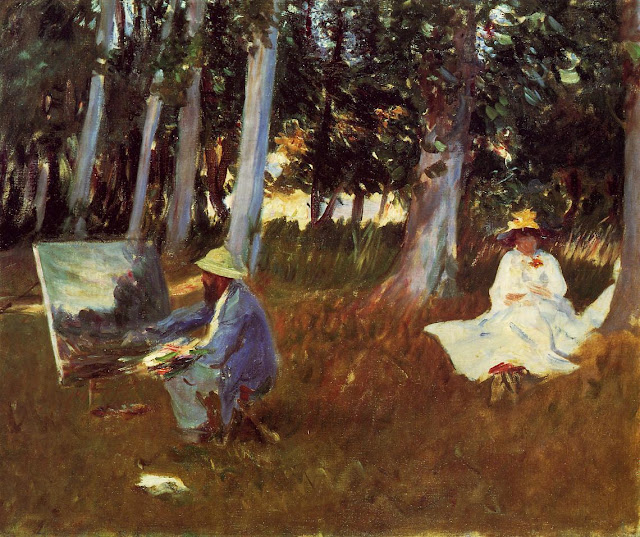
(Sarget, “Monet Painting”)

“Like a lot of realist painters, I started teaching as a way to stabilize my income. I was amazed to discover that it would be one of the most meaningful experiences of my life. Somehow everything I had learned in my life found a place in the studio classroom. In addition, teaching forced me to objectify my thoughts and make them comprehensible to my students. But the greatest reward by far was getting to know that special kind of person, the art student. Their hunger to learn, and commitment to what Henri called the art spirit, has been a never-ending inspiration to me. I’m sure I got the larger share in the exchange.

The list that follows was an effort to crystallize some of the things I’ve learned in over thirty years of teaching. It makes up a kind of horse wisdom about painting, practical advice rather than fancy aesthetics. This “survival kit” has proved useful to generations of young painters as well as its author. There is an awful lot of blather about art, not at all helpful to students. I hope these aphorisms are something of an antidote.

Several people have felt confused by number ten. By “drink a glass of water” I mean, “avoid running to the refrigerator every hour or so.” As I reread the list, I remembered the source of many of the ideas. So, here’s a “thank you” to Ben Franklin, Frederick Douglass, Robert Henri, Howard Pyle, Abraham Ginsburg, Ernest Hemingway, and Alexander Solzhenitsyn.”
 -Irwin Greenberg

NY Times: "Tracing the Spark of Creative Problem-Solving")

Thaliamuse of comedy, gazing upon a comic mask (detail from Muses’ Sarcophagus)
 

‎”Those with positive moods, turn out to be more likely to solve the puzzles with sudden insight than with trial and error.”

“…students solved word-association puzzles after watching a short video of a stand-up routine by Robin Williams. The students solved more of the puzzles over all, and significantly more by sudden insight, compared with when they’d seen a scary or boring video beforehand.”


“found that the visual areas in people in positive moods picked up more background detail, even when they were instructed to block out distracting information during a computer task.”

http://www.nytimes.com/2010/12/07/science/07brain.html

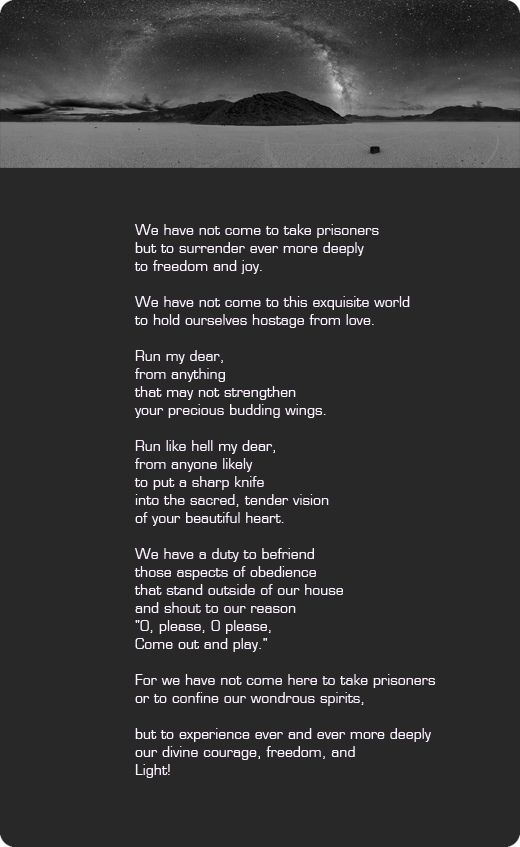
Welcome Splash Image with Short Poem for Facebook’s Hafez Page

(click for enlarged version)

An English language Facebook Page with more poetry may be viewed here: http://www.facebook.com/pages/Hafez-Persian-khwajh-shmsaldyn-mhmd-hafz-shyrazy/137434399601884?v=app_4949752878

(Facebook has a ‘Hefez’ Wikipedia Community page and dozens in Persian for him…but the only English language page uses ‘Hafiz’…and features none of his poetry…so….)