Soliciting Web Designers: Mars Society Site Redesign

The Mars Society is switching their entire online presence to a Google Sites hosting and design solution. This very robust, powerful platform will offer extensive integration with Google Docs, easy maintenance, and long-term viability. Design tools are limited but evolving. 
If you would like to help migrate the current site (MarsSociety.org) contact the Mars Society, here: http://www.marssociety.org/portal/author/MarsSocInfo 
The above screenshot is from the Mars Desert Research Station’s new (still beta) Google Site, here: https://sites.google.com/a/marssociety.org/mdrs/home

Special Offer on Print Version of the Journal of Cosmology’s "Human Mission to Mars: Colonizing the Red Planet"

We are pleased to announce that until December 31, 2010, the Journal of Cosmology is offering a discount to Mars Society members on the purchase of the print version of its highly acclaimed issue “Human Mission to Mars”

The print version of “Human Mission to Mars-Colonizing the Red Planet” can be purchased by Mars Society members for the reduced price of $50.00 through PayPal by using this link: https://www.paypal.com/cgi-bin/webscr?cmd=_s-xclick&hosted_button_id=KSW2PEG9PJGNL

After December 31, the retail price will be $124.00.  (You can become an International Mars Society member, and receive a discount on attending their annual convention, here: http://www.marssociety.org/portal/purchaseList#membership )

The Human Mission to Mars issue was released in October to an international audience. It was edited by Joel S. Levine, Ph.D., NASA, Co-Chair, Human Exploration of Mars Science Analysis Group (HEM-SAG) of the Mars Exploration Program Analysis Group (MEPAG), and Rudy Schild, Ph.D., Center for Astrophysics, Harvard-Smithsonian. It was presented in association and collaboration with The Mars Society.

For more information regarding the Journal of Cosmology, visit: http://journalofcosmology.com/

Pat Rawlings Image Gallery on the Mars Society’s Website

These paintings of Mars exploration by Pat Rawlings have been made
available by the artist to Mars Society members and chapters for free use in
producing charts and slides for public presentations. Those wishing to use
the art in commercial media, including magazines, film, and television, should
contact Pat Rawlings at [email protected]

“Distant Shores”

“After driving a short distance from their Ganges Chasma landing site, two
explorers stop to inspect a robotic lander and its small rover. This stop also
allows the crew to check out the life support systems of their rover and
spacesuits while still within walking distance of the base.”

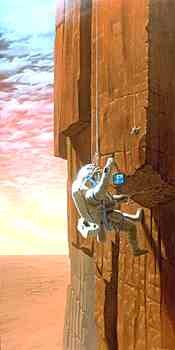
“Hard Science”

“Two kilometers above the lava flows of Mars’ Tharsis Bulge, a geologist
collects samples from the eastern cliff face at the base of Olympus Mons. To
understand the evolution of this Arizona-sized volcano, the scientist
investigates the layers of hardened lava that make up the massive feature.
The block-like nature of the rock face, caused by columnar jointing, is similar
to features on Earth such as The Devil’s Tower in Wyoming.”

“Another North Pole”

“Like the layers of a carrot cake, centuries of hot and cold seasons have left
Mars’ polar cap with alternating bands of white ice and red dust. Massive
icicles can also be found along the rims of thermally etched canyons.”

Pat’s personal website is at this url: http://www.patrawlings.com

His entire gallery of images available for the promotion of the Mars Society’s
endeavors can be seen here:
http://www.marssociety.org/portal/c/society-tools/mars_art/pat_rawlings_art


MarsArtGallery.com: A Showcase for Artistic Renditions of Mars Based on Robotic Mission Data

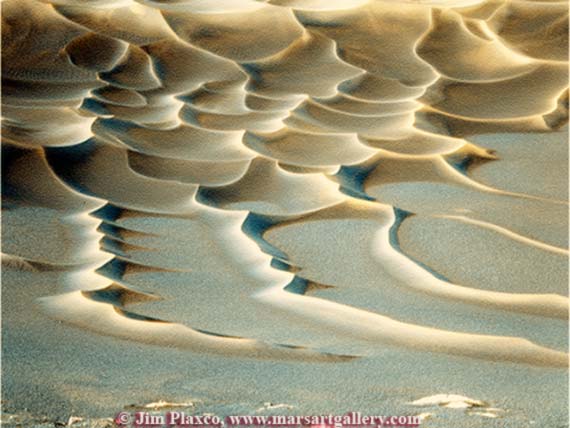
Sands of Mars
“Sands of Mars” Source: Mars Exploration Rover Opportunity
From a number of images taken by the Mars Exploration Rover Opportunity, this picture was constructed by Jim Plaxco, a digital artist, photographer and owner of Artsnova (http://Artsnova.com). Individual frames were all taken by Opportunity’s Left Panoramic Camera, with each frame being exposed using a different filter.
“Alien Spectrum” Source: Viking Lander 1
This second image is also hosted by the Mars Art Gallery, which was formally launched in March 2005 to serve as “a showcase for artistic renditions of Mars based on data returned by robotic missions.”  The above image, titled “Alien Spectrum” has been processed to depict Mars as it might be seen by: “eyes not of this Earth.  Evolution has given humans a set of eyes that are responsive to a particular range of electromagnetic radiations and we perceive those radiations as color.”  A wallpaper image and more information can be found here: http://www.marsartgallery.com/s_alienspectrum.html

Say Hello to ‘Cynthia,’ Feminine Robonaut with Attitude (by Ikan Loring)

Why do current robonauts look like adolescent dreams of a personal Boba Fett? Meet Cynthia, another variation of an adolescent’s dream. With a synthetic boa and pimped-out hat for character not only would a robonaut with breasts provide more room for tools, sensors, and batteries, but the whole shebang could be more fun (for most of us, to an extent) — and, who knows, maybe encourage more real breasts to go to space.  
Concept by Ikan Loring, digital artist ILM (thanks for including our logo!)

"Mars Has Arrived", Mission Coordination by Jonathon Keats

“The minerals, including pyroxene and ulvospinel and pigeonite, will be used by your body to make bone and tissue. Exploring Mars in this way, you’ll start to go native.” 
Conceptual Artist Jonathon Keats, referring to LASA’s “Martian Mineral Water,” says, “What’s important for me is that we set a precedent, and I believe that we’ve done that by demonstrating that exploring Mars is as easy as people are willing to let it be. In fact, we may have set two precedents: As Martian hybrids, those potatoes are the first alien life forms ever detected. And they’re not on some Goldilocks planet orbiting Gliese 581. They’re right here in California.”
“I think the mineral water may be an antidote for the madness we exhibit living on this planet. What is most revolutionary about Martian mineral water as a vehicle of exotourism is that it not only gives you a genuine Martian experience but also makes Mars a part of you. You’ll become a hybrid Martian/Earthling, a universal alien. If we became a bit alien, we might be able to discover more in common.”

A reception for LASA’s exotourism bureau lands Oct. 21 at San Francisco’s Modernism Gallery. Interested human exotourists can buy even a bottled Martian mineral water, if they want to go transhuman.
http://www.wired.com/underwire/2010/10/jonathon-keats-exotourism/?pid=1177&pageid=48482&viewall=true

Mars in Science Fiction (Author’s Panel, International Mars Society Annual Conference 2010)

Authors discuss the treatment of Mars in Science Fiction, their work processes, expectations for the field, and more. Panelists: Geoffrey Landis, Mars Crossing, Impact Parameter and Other Quantum Realities; Mary Turzillo, Mars is No Place for Children, An Old Fashioned Martian Girl; Robert Zubrin, First Landing, How to Live on Mars; David D. Levine, Space Magic.

CupCake! MakerBot Industries Cute Open Source 3D Printer

The Mars Foundation and Thingiverse team up with MakerBot’s off-the-shelf open source 3D printer to design and prototype models for use in Martian settlement. A library of open source designs is archived at Thingiverse online for anyone to “print” using a MakerBot.  Everything from screwdrivers to saxophones will come out of a little Martian machine like CupCake.  Practice now, submit your work, and help build a design archive which will be called upon for ages.  : )
MakerBot Industries – Robots That Make Things
MakerBot overview featured on Google Tech Talks YouTube Channel
MakerBot YouTube Channel
Thingiverse

Mars Foundation "To Arrive, Survive, & Thrive!"

The mission of the Mars Homestead Project is to design, fund, build and operate the first permanent settlement on Mars. The initial goal for the Mars Homestead Project is to identify the core technologies needed for an economical, growing Mars Base built primarily with local materials. Efforts will then be focused on prototype projects of increasing sophistication. The Mars Foundation has also established a small board of technical advisors  who provide expertise in specific areas, and created a general “brainstorming” discussion group which is open to the interested public, regardless of their technical experience.

Mars Foundation “To Arrive, Survive, & Thrive!”
http://www.marshome.org/

Mars Foundation Artist’s Concepts Gallery
http://www.marshome.org/images2/

Started ‘Mars to Stay’ Facebook Page

Mars to Stay is the proposal that astronauts sent to Mars for the first time should stay there indefinitely, both to reduce mission cost and to ensure permanent settlement of Mars. Under a Mars to Stay mission architecture the first humans to travel to Mars will be composed of a six-person team. After this initial landing subsequent missions will raise the number of persons on the Martian surface to 30 within a few years, thereby beginning an organically evolving Martian settlement.

Since the Martian surface offers all the natural resources and elements necessary to sustain human society—unlike, for example the moon—a permanent Martian settlement is thought to be the most effective way to ensure humankind becomes a space-faring, multi-planet species. For more information, see: http://en.wikipedia.org/wiki/Mars_to_Stay and of course…