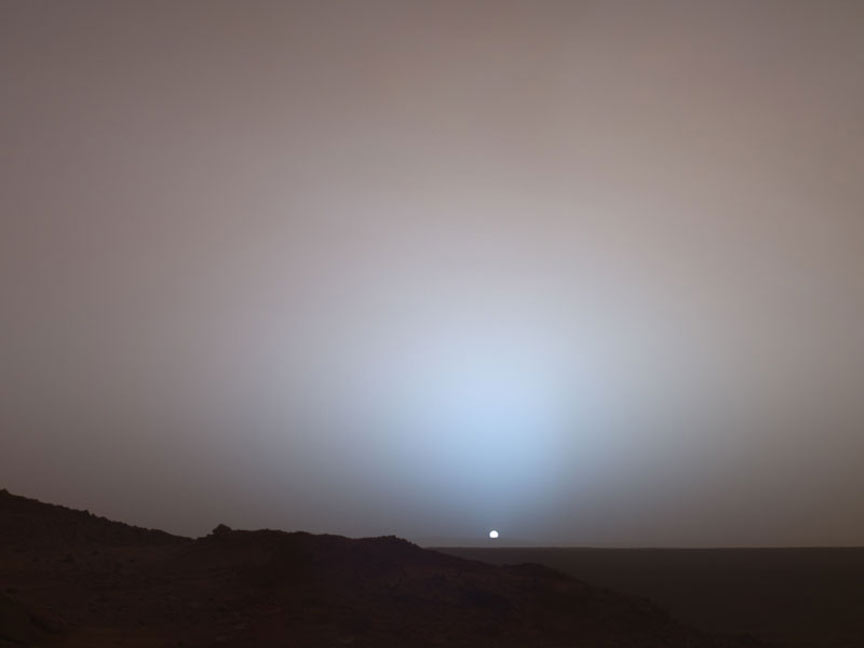
Come on, Get Happy!! (How to Portray Martian Settlement)

Life on Mars will be FUN!  We will have 24/7 wall-sized Skype murals with permanently open delayed stream of whatever you want to see on Earth (if that is an issue).

Please…if you advocate Mars settlement it would be helpful not to emphasize actually surmountable challenges. Phrases such as these pollute the public’s imagination:

“I envision life on Mars to be…frightening, lonely, quite cramped”

“It’s going to be a very long period of isolation and confinement”

“After the excitement of blast-off, and after the initial landing on Mars, it will be very difficult to avoid depression. After all, one is breaking one’s connections with family, friends, and all things familiar”

“Each day will be pretty much like the rest. The environment, once the novelty wears off, is likely to be deadly boring. Despite being well prepared and fully equipped there are certain to be unanticipated problems that cannot be remedied. One by one the crew will get old, sick, and die-off.”

“I do very well with solitude.”

We must make this negative portrayal of Martian settlement incomprehensible.  As strange as if someone were to suggest standing under Earth’s blue skies would lead to feelings of paralysis, suicide, or aesthetic bias toward non-photo blue. (In other words, ridiculous.)

The story of Mars will not be one of danger.  It will not be written by timid academics. The question frightened armchair astronauts should be asked is, “How often does your mom really want to Skype with you — on Earth??”

Humans on Mars will paint, play guitar, raise children, plant flowers, and have vibrant loving families. There is nothing solitary or depressing about the place.

(And they will have great relationships with their moms.)

Ridiculous, embarrassing article from which the quotes above were taken:
http://www.foxnews.com/scitech/2011/01/10/space-volunteer-way-mission-mars/#ixzz1jLhRlYvW

Earth as Seen from the Surface of Mars (& Musk quote)

[Image: NASA, posted on Facebook by Milky Way Musings]
 

This picture, taken from the surface of Mars, is the first taken of our home world from the surface of another planet. This is the view that future human pioneers on the Red Planet will have of their former home.

“Ultimately we don’t really want 10,000 people on Mars,” Musk says, after letting the pause linger a few seconds more. “We want millions.”

Fantastic interview with SpaceX’s Elon Musk here: http://www.marssociety.org/home/press/illputmillionsofpeopleonmarssayselonmusk

2012 Mars Society Poster Contest

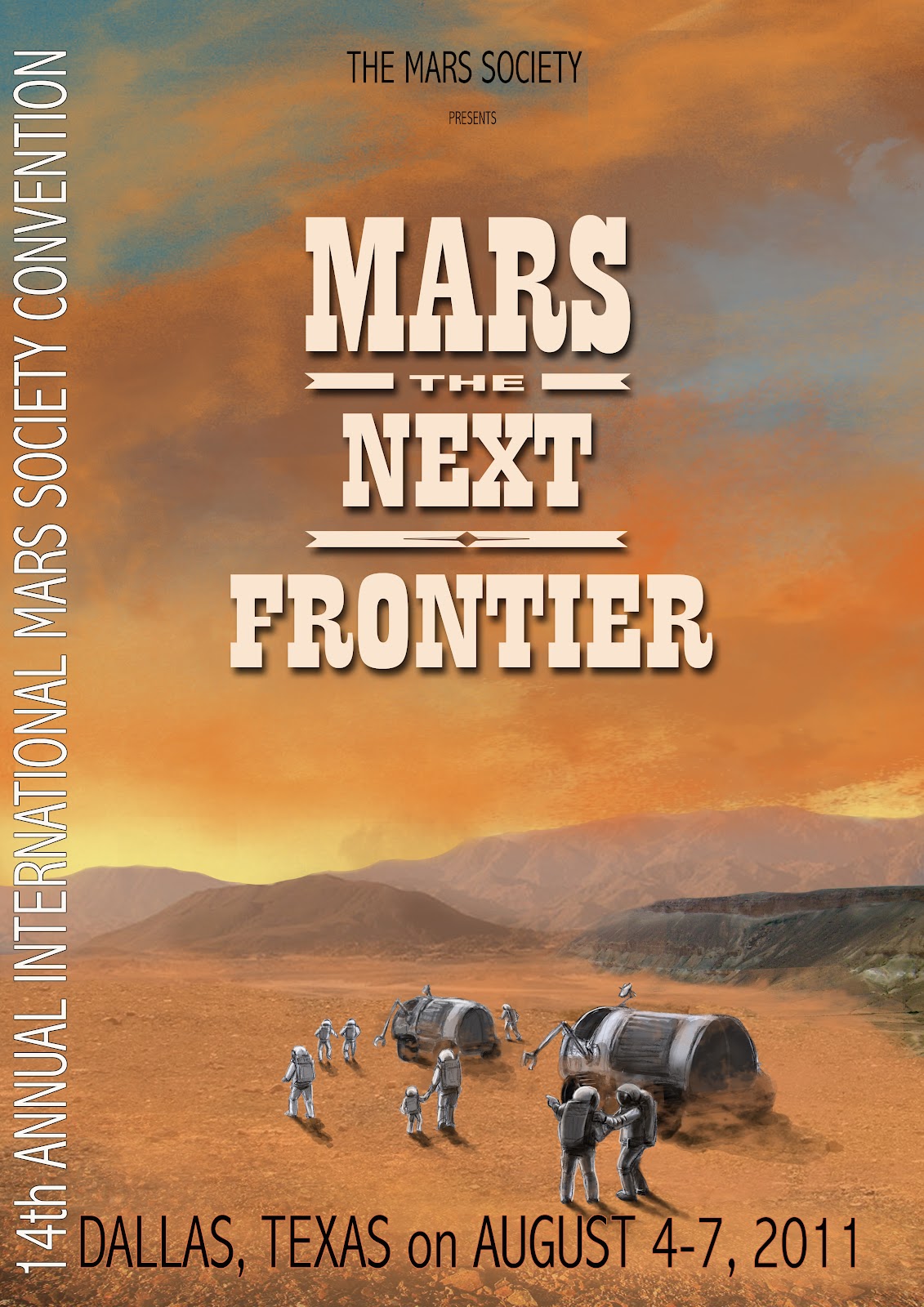
The 2012 Mars Society Poster Contest is now underway!  The winning design will be used as the primary graphic for promoting the 15th Annual International Mars Society Convention, to be held in Pasadena, California, August 3-5, 2012.

Winner of 2011 Mars Society Poster Contest

When designing posters, members and friends are asked to use the main themes of the 2012 convention: “Mars Science Laboratory rover”, “robotic exploration” and “finding life on Mars”.  The poster should seek to emphasize the critical importance of robotic research and exploration of the Red Planet as a key stepping stone to a humans-to-Mars mission within the decade.

The winner will receive free admission to all sessions of the convention in Pasadena, which will include a ticket to the main convention banquet and (tentatively) the viewing of a live broadcast of the MSL landing on the Martian surface on the evening of August 5.  [Airfare and hotel accommodations are not included.]
The deadline for submitting all poster designs is Friday, February 3, 2012 at 5:00 p.m. EST.

With regard to technical requirements for the contest, the poster size should be 11″ x 17″.  There are no restrictions on color.  If your poster is chosen, in addition to the full color poster we will need a gray-scale copy.  Posters can be submitted as a .pdf file, although it is preferred in the original format (i.e., Photoshop).

To submit your poster, please e-mail the sample to: [email protected]  Please also use this e-mail address for any questions regarding the contest and/or the submission process.

io9 Article on Space Themed Storytelling

io9, a daily publication that covers science, science fiction, and the future has published a fun thought provoking article on space themed storytelling. 
(Please click through to read the article in full.)

Why Adding “In Space” Makes It Better

Everybody always says that every story idea has been done before – which is totally not true, because nobody’s done a “nuns raise an ostrich to be the perfect killer” story before. But even if a story idea has been done to death, you can always make it fresh and brilliant all over again, by adding just two little words: “in space.”
Science fiction fans have known this forever, but it’s time that everybody was told. There is no genre, no type of story, no set of story beats, that cannot be improved by adding “in space.” It bears the same relation to storytelling that “in bed” does to fortune cookies. And we’ve got the proof, right here.

NASA Space Launch System: Next-Gen Heavy-Lift To Mars

“It’s also a shift in emphasis from the moon-based, solid-rocket-oriented plans proposed by the George W. Bush administration. NASA figures it will be building and launching about one rocket a year for about 15 years or more in the 2020s and 2030s, according to senior administration officials who spoke on the condition of anonymity because the announcement was not yet made. The idea is to launch its first unmanned test flight in 2017 with the first crew flying in 2021 and astronauts heading to a nearby asteroid in 2025, the officials said. From there, NASA hopes to send the rocket and astronauts to Mars – at first just to circle, but then later landing on the Red Planet – in the 2030s.”

“The key financial part of this arrangement is that NASA hopes to save money by turning over the launching of astronauts to the International Space Station, which orbits the Earth, to private companies and just rent spaces for astronauts like a giant taxi service. NASA would then spend the money on leaving Earth’s orbit and the Earth-moon system.”

Spacelog: Project to Publish Transcripts of Early Spaceflight

Read the stories of early space exploration from the original transcripts. Now open to the public in a searchable, linkable format. “Reminds us of why the internet is so insanely awesome.” –Engadget

“To date there have been over two hundred human spaceflight missions. Only a small number of these are currently available on Spacelog, although we’d be delighted for assistance in getting more up and alive.”

Spacelog is a volunteer project that anyone can contribute to!

Creating A Better Narrative: Sacrificing the Science?

Image by Framestore CFC, used in “Space Odyssey: Voyage to the Planets” (BBC, 2004)
(thanks to Max Champion for identifying the source of this image)

Second in a series of posts from guest writer Joi Weaver 
in preparation for NaNoWriMo.

The common wisdom in creating stories about real science is: don’t. You either lose your audience or deal with scientists who ridicule your story as unrealistic or dumbed-down. For example, see every movie about Mars for the past 50 years. Is there anything in there that is both dramatically compelling and acceptably scientifically accurate?

Is this divide necessary, or have we just not told the right stories in the right way yet? Imagine if realistic science fiction about space colonization started outselling vampire romances? It’s completely possible, but only if we start creating narratives that can capture the imagination and flood the market. We don’t have to sacrifice the science, but the narrative must be compelling. When the general public is more interesting in supernatural romances and pirate stories, we don’t have the luxury of being science snobs.

I believe the problem is simply that we haven’t yet told enough of the right stories in the right way. The movie Apollo 13 demonstrated that people do care about science-heavy stories, as long as the drama is compelling. (Lest you doubt that Apollo 13 is science-based, think of the time spent in the movie explaining to the audience about the equipment inside the command module and re-entry angles.) This isn’t limited to historical accounts, either. Give an average sci-fi fan a copy of Red Mars and see what happens.

But for now, let me take as an example the book Roving Mars by Steve Squyres, the Principal Investigator for the MER mission. If you haven’t read it yet, I highly recommend it. After you’ve read it, give it to someone who thinks the human presence in space ended with the shuttle program.

Squyres brilliantly dramatizes the science in Roving Mars. Enough detail is given about the construction and function of the major components of the Mars Exploration Rovers to enable the reader to feel anxiety when a part breaks or refuses to function as intended, or a deadline creeps closer during testing. The difficulties in getting funding and approval from NASA play out more like office dramas than anything on NASA TV: and who hasn’t had trouble getting their boss to understand their pet project?

The majority of the book discusses the time prior to the launch of the rovers: the first third is simply getting approval for the mission! A sense of frustration as the mission meets delays, obstacles, and budget issues is palpable, but it never slows the narrative. There’s plenty of science to be found in Roving Mars: basic descriptions of the equipment on board, explanations of the conditions the spacecraft have to endure, and information about technological problems that occurred during testing. It’s far from “dumbed-down.”

What Squyres does brilliantly in this story is use science to create a narrative to which readers can relate. His description of PANCAM isn’t there to show how cool the tech is, it’s there so the audience will understand why it’s an important piece of equipment and what the stakes would be if it were lost. The same goes for the solar panels, the Mossbauer, and most of the payload.

As good as Roving Mars is, however, it’s not enough. Space geeks often fall prey to the temptation of looking for a “silver bullet,” a cultural artifact strong enough to improve the public’s view of space exploration with a single blow. The silver bullet doesn’t exist. Changing public perception is more like Chinese Water Torture: one little drop at a time. We don’t need a better Roving Mars, we need hundreds more like it.

How do we get those hundreds of stories? When we start creating them. See part 3 of this series next month for more ideas on how to do that.

Joi Weaver’s “MARS BLOG PROJECT: MISSION”

Feng Zhu School of Design: Inspiration for Concept Artists

Concept designs depicting Lockheed Martin’s Orion and SpaceX’s ‘Red Dragon’. 
(If artists responsible for rendering these images would please contact us we would love to feature posts dedicated to your work: [email protected] )

A fantastic resource from which even professionals can glean tips is the YouTube channel to which concept designer Feng Zhu generously posts many tutorials:

Just please no depictions of guns, monsters, or shiny Battlestar Gallactica vehicles…
Check out our “Guide to Mars Positive Art“

The Importance of the Narrative: Tell Them a Story

(First in a series of contributions from our guest author Joi Weaver)

I’m sure we’ve all had the same experience. Caught up in the excitement of a new Mars mission, or a new photo from the surface, or even a new bit of tech that could help in the colonization of the Red Planet, you look up to find the person you’ve been talking to staring at you with glazed eyes. Your heart sinks as you realize, they just don’t get it.

How do we help people see what is exciting about space exploration in general, and Mars exploration in particular? I believe it boils down to one simple thing: it’s all about the narrative.

The early space missions had a story that anyone could grasp: we were sending men to the moon! It was dangerous! It was exciting! It was putting our country in the forefront of science! This narrative kept public attention and support for the space program high through the Mercury, Gemini, and early Apollo missions.

But it fell short, ultimately resulting in an early cancellation of Apollo and hamstringing all future NASA spaceflight. Why? No-one ever developed a new narrative. “We’ve beaten the Russians to the moon,” most people thought, “isn’t that the end of the story?”

Of course it’s not the end. But you wouldn’t know that to talk to the average person-on-the-streets. Many people believe the shuttle was capable of lunar landings and had no idea the whole shuttle program was coming to an end until a few months ago. NASA, for all its media presence, failed to provide a new narrative. In the post-Challenger era, NASA decided to stress the safety of spaceflight, despite the fact that it is the riskiest human endeavor possible. NASA TV became little more than clean-cut men and women floating in a sterile environment, smiling as they talked in acronyms that meant nothing to the public: it was very safe, but it was terrible story-telling.

What does this mean for Mars?

Mars is still a blank slate in the public mind. Some of the more well-informed people may know about the rovers, but that’s about it. This is an opportunity. We can still set the narrative for Mars, and more importantly, learn from NASA’s mistake: the story can’t just be about getting there, or we may never go back after the first trip.

A narrative is almost never set by a single person; rather, it’s a hundred little stories that slowly take root in the heart and mind of the people, gradually changing the way we see the world. No-one can say that the MER program happened because Ray Bradbury wrote The Martian Chronicles. But would it have happened, or happened in the same way, if he hadn’t written it? Where would the space program be without Bradbury, Asimov, Clarke, and a hundred others who fanned our desire to explore?

It’s time to start creating the narrative for Mars, to show the Red Planet as we know it: a place of danger, beauty, and adventure. A place that could, eventually, become home.

In May, I began a work of fiction, a blog purportedly written by the first private colonists on Mars. Though the characters I’ve developed may write about the weather conditions, the  environment, and the technical difficulties of living on the planet, they also write about what it is like to make Mars home, how it feels to live on the new frontier, and what this colony means for humanity. These characters are creating a narrative for Mars that goes far beyond the race to land on the surface. They are finding a way for people to think of Mars as “home.”

The frontier is open. Let’s start telling the stories.

Joi Weaver’s “MARS BLOG PROJECT: MISSION”
http://mars.sonrider.net/index.php