Going Nowhere: Give NASA the Destination MARS!

From an essay in the Spring 2010 print edition of “The New Atlantis,” an article titled Going Nowhere by Robert Zubrin, President of the International Mars Society:

“The shuttle-era record is [not] impressive; it resulted in no new technologies of importance and reached no new destinations — despite the fact that the agency’s budget for the past twenty years has been approximately the same, in inflation-adjusted dollars, as that which it enjoyed during the Apollo period. In the Apollo Mode, NASA’s efforts are focused and directed; in the Shuttle Mode, the space agency’s efforts are random and entropic, shuffling along without a purpose, always buffeted by political winds.

Without the guidance supplied by a driving mission, under the new Obama space policy, another ten years and more than a hundred billion dollars will be spent by NASA’s human spaceflight program without achieving anything significant. We may take part in another twenty flights to low-Earth orbit, but there is no new world there to explore. Together with the Russians, we have already flown there some three hundred times over the past half-century. Spending a king’s ransom to raise that total to three hundred twenty hardly seems worthwhile.

But it must be remembered that NASA’s average annual budget from 1961 to 1973, during the years when the agency flew all the Mercury, Gemini, Apollo, and Skylab missions, as well as scores of lunar and interplanetary probes, was about $19.7 billion (converted to today’s dollars). That figure is very close to NASA’s current budget.

Mars is the closest world that truly has the resources needed for human settlement. For our generation and those that will follow, Mars is the New World.

Four decades of stagnation in space is enough. If any progress is to be made, a course must be set. Leadership is required. President Obama should reject the timid proposal his administration floated in February, which would mark the end of the American human spaceflight program, and should instead take the side of audacity and hope — by committing NASA to reach for Mars in our time.”

http://www.thenewatlantis.com/publications/going-nowhere

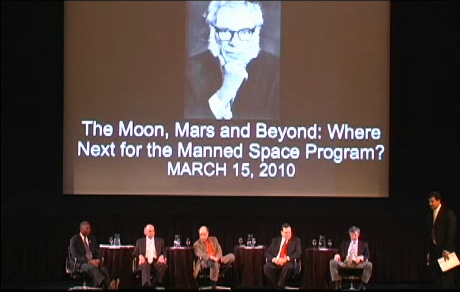
Note the Destination Boring People Advocate…Isaac Asimov debate at the Hayden Planetarium (thanks to Landmark Pictures)

Factual corrections to points made by Paul Spudis: eight week round-trip missions to NEAs have been proposed (see earlier posts on this blog); most asteroids rotate at very, very low speeds; most do not have “co-orbiting clouds of debris;” resources will be collected at asteroids and processed in artificial ‘gravitational’ environments at LEO.  These are exciting, solvable engineering challenges.  Solvable.

Bob Zubrin:
“From a technical point of view, we’re much closer today to sending humans to Mars than we were to sending men to the Moon in 1961. […] While there are resources on the moon there are vastly more on Mars. There’re continent sized regions on Mars that are 60% water in the soil. There’s complex geological history which has created mineral ore. There’s carbon, which is necessary for life and for plastics. There’s nitrogen. There’s a twenty four hour day. […] The reason why it is important to do something as hard as exploring and ultimately settling Mars, is because of what it would do for opening up and creating the prospect of a human future with an open frontier rather than a limited frontier of a world of limited resources, in which choices are becoming ever closer and smaller and freedom is ever more limited.“

“As far as robots versus humans despite the fact that I am a robot guy, you can’t send humans out to explore the solar system soon enough — for me. As an example, what our magnificent robots have accomplished for six years on Mars — Paul is a geologist — Paul and I could’ve done it in about a week. Okay? So robots fall far short of what you can do with humans. […] I firmly believe the best exploration and the most inspiring exploration can only be done by humans. […] Asteroids have very low gravity so you don’t have to go down into a gravity well and come back out again. There are asteroids that are incredibly rich in carbon, there are asteroids that are incredibly rich in metalic minerals: iron, nickel, and all sorts of trace elements. So everything Paul Spudis is talking about on the moon, you can get it better on an asteroid. Asteroids are an incredibly rich source of raw materials. […] There’s a lot more to mine on asteroids than there is on the moon.” 

If Lunar advocates were at a bar they’d drink alone. Soda. After having attended several space-related conferences each year for over a decade, one characteristic of moon-first advocates which has been unfailingly predictable: they are boring as hell.

The full debate may be viewed here, thanks to Landmark Pictures:

_____2010 International Mars Society Convention Poster____ Designed by Former Ogilvy and Mather Art Director Mike Neal

Congratulations Mike Neal! Easily the coolest design for any space-related event
in the last 10 years; exceptional artists by nature want to see humans on Mars.

Mike Neal is a design and architectural writer currently completing his MFA at the School of Visual Arts in New York City as part of the inaugural class of its graduate design criticism program. He was born and raised in Southern California, where he worked for many years, first as a graphic designer, then as an art director for the Los Angeles office of the worldwide branding and advertising agency, Ogilvy and Mather.

As part of his critical studies, Mike has focused on examining the fields of space architecture. His graduate thesis deals specifically with the historical links to Modernist design theory in relation to current planning and design that would accompany the first human explorers to Mars. For first hand research Mike served as the journalist and executive officer for the Mars Society’s 84th crew at MDRS.

The concept for Mike’s design for the Society’s upcoming convention was initially inspired by a quote by architect and designer, Buckminster Fuller, who decades ago had tried to pioneer a design/science revolution. Always a challenger of the status quo, Fuller was particularly scrutinizing of the language we use to describe our universe; he once noted, “If you still use the terms up and down, you’re still thinking in terms from the dark ages.” Fuller argued instead there was only “in”, towards the Earth’s gravitational center, and “out,” towards space.

This idea is translated in the convention poster in the constantly shifting perception of orientation of both space and time. Up and down—in and out—are in a state of flux between the gravitational centers of blue Earth and vermillion Mars, as ground and sky interchange. The conventions theme also changes though maintaining its intent; “Reaching Higher,” as the Wright brother’s did in their first flight, and continuing on that trajectory to the “Higher Reaching” goal of Mars.

Astronauts with Personality — Please!! …Following the Mars Society Convention 2010: STURGISSSSS!!

Immediately after the Mars Society Convention we’re going to Sturgis to party, drink hell and shoot machine guns — depending upon how much money we have left after whiskey. If you don’t have a bike — no problem. You can rent from a Harley dealer in Ohio or on the way. We’re camping along the side of the road. Basically, this is a balls reenforcement project for Men who are WORKING HARD to see humans on Mars in their lifetime. If you want to go incognito that can be arranged (for example, if you are James Cameron)…no women invited. They will meet us in Sturgis.

Rebels only.

It’s not personal, #ItsNotYouItsDefinitelyUs. If you’re tired of marriage to or dating a passive characterless ass-kissing academic limp-dicked system-worm give him a few days riding under the stars to Sturgis. We’re ramping testosterone among advocates of Humans to Mars. It’s become a requirement of our passionless world. This is an unsanctioned event without supervision very intentionally fatal to betas. Have bail ready.

Update: get a motorcycle license now from your local Harley dealer following a two day lesson for less than $200.
Since artists interested in promoting ‘humans to Mars’ are of any gender, it is encouraged that women either form a girls-trip to Sturgis or meet us there. In theory it would be possible to meet periodically along the way, but, that would be unlikely. Impossible, in fact. If you look like Angelina Jolie you could try, but it still won’t help. There’ll be enough women along the way.

Google Search:
“Masculate” 14,900 results.
“Emasculate” 309,000.  This is part of the problem.

(If you show up with anything other than a Harley or KTM 950 Adventure you’ll be disinvited. No exceptions. That includes you and your bullshit Triumph Angelina.)

Oh God I love this blog

James Cameron…Lone Voice in the Wilderness

James Cameron, the writer and director of “Avatar” and “Titanic,” served on the NASA Advisory Council from 2003 to 2005, and has led 6 deep ocean expeditions.  He is currently a co-investigator on the Mars Science Laboratory Mastcam team and a lifetime member of the Mars Society.  (This commentary also appeared in the February 5 edition of the Washington Post.)

.

Rockets Run on Dreams

.
What do rockets burn for fuel? Money. Money that is contributed by working families who have mortgages and children who need braces. And why do the American people support our efforts in space? Because they still believe, to some extent or another, in that shining dream of exploring other worlds. So it could be said that rockets really run on dreams.

.
The exploration of space is the grandest adventure challenging the human race. As a filmmaker I have celebrated this greatest of dreams in my movies and documentaries, and I remain as passionate about the discoveries ahead as I was when I was a kid. So it was with some trepidation that I waited for the NASA budget to be unveiled this week. I was concerned that amid the nation’s fiscal crises, space exploration would fall off the priority to-do list. But the new NASA budget reveals a pathway to a bright future of exploration in the coming years. It simply reflects the deep changes and hard decisions necessary to accomplish that goal.

.
Last year President Obama instructed the Augustine commission to report on the likely prognosis for NASA’s exploration activities. After months of study, the conclusions the panel released last October were gloomy. The Constellation program, implemented in XXX and designed to put humans back on the moon by 2020, could not possibly succeed within that timeframe or for the budgeted amount, it reported.

.
In response, the president and NASA have crafted a bold plan that truly makes possible this nation’s dreams for space. Their plan calls for the full embrace of commercial solutions for transporting astronauts to low Earth orbit after the space shuttle is retired next year. This frees NASA to do what it does best: deep space exploration, both robotic and human. By selecting commercial solutions for transportation to the International Space Station, NASA is empowering American free enterprise to do what it does best: to develop technology quickly and efficiently in a competitive environment.

.
As Peter Diamandis, chairman of the nonprofit X-Prize foundation, said in a recent blog, “The U.S. government doesn’t build your computers, nor do you fly aboard a U.S. Government-owned and -operated airline. Private industry routinely takes technologies pioneered by the government and turns them into cheap, reliable and robust industries.” When the shuttle is finally retired after more than three decades of service, the United States will be dependent on the Russian Soyuz to get our astronauts to the International Space Station, at a cost of $50 million per person. But under the new NASA plan, private industry will take over this capability within a few years, much more quickly than Constellation would have, and at a competitive price.

.
The money saved will be plowed into research and development of robotic explorers that will act as precursors and technology demonstrators, paving the way for human exploration of the moon, asteroids and Mars. Additional funding has been committed to the development of advanced propulsion technology, which can bring down the cost of spaceflight. And the space station’s lifespan will be extended several years, which in turn will increase the science yield and satisfy our international partners. This international cooperative effort is important as a model for how future large-scale missions will be organized and funded. In addition, money is being made available to both Earth and planetary science, which can help us understand climate change on our own world and the alien processes at work on some of the other worlds in our solar system.

.
Over the past 15 years, I have gotten to know a lot of people at NASA while working on projects to advance space and ocean exploration. I’ve found that many, if not most, started as starry-eyed childhood dreamers. Maybe they loved science-fiction stories, with their promise of alien worlds, or maybe they were geeks like me, peering through a telescope in the back yard until their moms yelled again for them to come inside, “it’s a school night!” They grew up to become engineers, brilliant planetary scientists and steely-eyed missile men, who collectively have pushed our human presence out to the moon and our robotic presence not just to Mars but to the outer reaches of the solar system. I applaud President Obama’s bold decision for NASA to focus on building a space exploration program that can drive innovation and provide inspiration for the world. This is the path that can make our dreams in space a reality.

What the Hell Happened to Our Space Program?? Can you imagine the Right Stuff generating these fucking headlines??

ONN: NASA Scientists Plan to Approach Girl by 2018
“Our backup plan: using the Hubble Space Telescope to take high-resolution photos of her and
then masturbating furiously while hating ourselves for it.”

NASA Launches David Bowie Concept Mission
“These new suits are veneered with a protective silver lamé to complement the multicolored lightning bolts emblazoned across the helmets’ sun visors. They’ve also been updated with several improved components to ensure the team is completely safe when it’s time to leave the capsule—if they dare.”
NASA Is An Industrial Subsidy In Disguise
I grew up with the romantic notion that NASA is not merely a government agency, but an organization dedicated to bravely propelling the human race forward into a glorious future of scientific advancement and discovery […but…] NASA exists largely to provide an economic boost to the American aerospace industry, particularly Boeing. NASA gets away with this thinly veiled pork-barrel politicking, the piece contended, by distracting the public with “bread-and-circus” space missions that emphasize thrills over genuinely useful scientific discovery.>
Consider the hoopla surrounding John Glenn’s return flight to space. He got a ticker-tape parade and front-page coverage, but what did science actually gain? …it’s time we started making NASA accountable for its wasteful, PR-driven expenditures.
NASA Baffled by Failure of Straw Shuttle
$68 billion straw space shuttle [… ] “It was nice and crisp and dry,” Toshikima said. “Which is the best condition for straw headed away from the earth’s gravitational pull.” The Explorer 2, like its predecessor, was headed for the sun, where it was to be the first spacecraft to land on a star. “We’d hoped to bring back and study sun rock,” Toshikima said.”
NASA Announces Plan to Bring Wi-Fi to Its Headquarters by 2017
An ambitious mission to make Houston’s Johnson Space Center wireless-Internet capable within one decade. We are not content to rest on our laurels. It may seem like an impossible task, but if we commit all of our focus, technology, and resources, we can get Wi-Fi into NASA’s offices and research labs within our generation.”  Griffin was confident that NASA’s estimated $655 million plan to install a wireless broadband router by 2017 could reap huge benefits for the entire space agency.
NASA has suffered from a public credibility crisis in recent years due to perceived incompetence, a failed mission to Mars, the damaged and dormant Hubble telescope, and its inability to procure a long enough USB cable to reach all the way over to engineer William Chen’s cubicle. But NASA officials argue that a secure high-speed line could prevent disasters such as a 2005 incident in which an employee attempting to download the movie trailer forCheaper by the Dozen 2  crashed the Mission Control Center mainframe computer for two weeks.
NASA Embarks on Epic Delay
The unprecedented delay has reportedly brought together the nation’s foremost aerospace engineers, whose combined efforts have already added 18 months of rescheduled meetings to the daring mission. “Delays of this magnitude were once the stuff of science fiction,” Scolese told reporters during a noon press conference Monday that actually started around 3:15 p.m. “But now, thanks to a number of long-overdue technological advances, this historic delay will stretch the very limits of what humankind can push back indefinitely.”
“Never before has man dared to fall behind on such a sweeping scale,” said Brenda Win, head administrator of the newly established delay-management team, which is expected to be named sometime next month or maybe the month after. “A postponement like this only happens once in a lifetime. This will be the series of setbacks you’ll tell your grandchildren about.”

“When we have finally finished here, the universe will see there is no end to what man can entangle in red tape,” Scolese wrote in the stirring statement. “Even as we speak, our top people are dragging their feet on what will become the longest and most profound delay in the planet’s history.”


“Mark my words: In our lifetime, NASA will delay putting a man on Mars,” Scolese continued. “Well, maybe not in my lifetime. I’m almost 50.”
Vows to Put Man on Moon Before It Disappears At End of Month
The president went on to propose the construction of a lunar capsule that could land on a concave surface.
NASA Delays Shuttle Launch Out of Sheer Habit
NASA To Send Earth Into Space

http://www.theonion.com/content/node/35905

People Living On The Moon
“Golden throne so tourists can have their pictures taken as the Moon King.”
Scientists Ask Congress To Fund $50 Billion Science Thing
I have always said that science is more important than it is unimportant,” Committee chairman Rep. Bart Gordon (D-TN) said. “And it’s essential we stay ahead of China, Japan, and Germany in science. We are ahead in space, with the NASA rockets going to other planets, so we should be ahead in science too.”
“Now, I’m no science major, but if I’m being told by a group of people that the protons, neutrons, and electrons need unifying, then I think we owe it to the American people to go in and unify them,” Rep. Mark Udall (D-CO) said. “After all, isn’t a message of unity what we want to send to our children?”
Conspiracy Theorist Convinces Neil Armstrong Moon Landing Was Faked
According to Armstrong, he was forced to reconsider every single detail of the monumental journey after watching a few persuasive YouTube videos, and reading several blog posts on conspiracy theorist Ralph Coleman’s website, OmissionControl.org.  “This is all just common sense, people,” he added. “It’s the moon. You can’t land on the moon.”
NASA Announces Plan To Launch $700 Million Into Space
fficials at the Kennedy Space Center announced Tuesday that they have set Aug. 6 as the date for launching $700 million from the Denarius IVspacecraft, the largest and most expensive mission to date in NASA’s unmanned monetary-ejection program. “This is an exciting opportunity to study the effect of a hard-vacuum, zero-gravity environment on $50 and $100 bills,” said NASA Administrator Michael Griffin, who noted that prior Project Denarius missions only studied space’s effect on fives and singles.

New York Times Favors MARS FIRST!! $&%# the $*&@ Moon!

In its lead editorial February 9, the New York Times called on the Obama administration to make human missions to Mars the goal of the American human spaceflight program. A complete discussion of the current political situation and potential initiatives for dealing with it will be held at the 13th international Mars society convention, August 5-8, 2010, Dayton Mariott, Dayton, Ohio. Registration for the conference is now open at www.marssociety.org.

Commenting on the administration’s new space policy released February 2, the Times said:

A New Space Program

February 8, 2010

President Obama has called for scrapping NASA’s once-ambitious program to return astronauts to the Moon by 2020 as a first step toward reaching Mars. That effort, begun by former President George W. Bush, is behind schedule and its technology increasingly outdated.

Mr. Obama is instead calling on NASA to develop “game-changing” technologies to make long-distance space travel cheaper and faster, a prerequisite for reaching beyond the Moon to nearby asteroids or Mars. To save money and free the agency for more ambitious journeys, the plan also calls for transferring NASA’s more routine operations — carrying astronauts to the International Space Station — to private businesses.

If done right, the president’s strategy could pay off handsomely. If not, it could be the start of a long, slow decline from the nation’s pre-eminent position as a space-faring power. We are particularly concerned that the White House has not identified a clear goal — Mars is our choice — or set even a notional deadline for getting there. The National Aeronautics and Space Administration and Congress need to keep the effort focused and adequately financed.

The most controversial element of the president’s plan is his proposal to scrap NASA’s mostly Moon-related technology programs that have been working to develop two new rockets, a new space capsule, a lunar landing capsule and systems for living on the lunar surface. Those efforts have been slowed by budgetary and technical problems. And at the current rate, the Moon landing would likely not occur until well after 2030. The technologies that looked reasonable when NASA first started in 2005 have already begun to look dated.

A lunar expedition would be of some value in learning how to live on the Martian surface but would not help us learn how to descend through Mars’ very different atmosphere or use that planet’s atmospheric resources effectively. Nor would it yield a rich trove of new scientific information or find new solutions for the difficulties of traveling deeper into space.

The president’s proposal calls for developing new technologies to make long-distance space travel possible: orbiting depots that could refuel rockets in space, lessening the weight they would have to carry from the ground; life-support systems that could operate indefinitely without resupply from Earth; new engines, propellants and materials for heavy-lift rockets; and advanced propulsion systems that could enable astronauts to reach Mars in a matter of weeks instead of roughly a year using chemical rockets.

Leaping to new generations of technology is inherently hard and NASA’s efforts may not bear fruit in any useful time period. To increase the odds of success, Congress may want to hold the agency’s feet to the fire and require that a specified percentage of its budget be devoted to technology development.

The idea of hiring private companies to ferry astronauts and cargo to the space station is also risky and based on little more than faith that the commercial sector may be able to move faster and more cheaply than NASA. The fledgling companies have yet to prove their expertise, and the bigger companies often deliver late and overbudget.

If they fail or fall behind schedule, NASA would have to rely on Russia or other foreign countries to take its astronauts and cargoes aloft. That is a risk worth taking. It has relied on the Russians before when NASA’s shuttle fleet was grounded for extensive repairs. It would seem too expensive for NASA to compete with a new rocket designed to reach low-Earth orbit — far better to accelerate development of a heavier-lift rocket needed for voyages beyond, as NASA now intends.

The new plan for long-distance space travel also needs clear goals and at least aspirational deadlines that can help drive technology development and make it clear to the world that the United States is not retiring from space exploration but rather is pushing toward the hardest goal within plausible reach.

We believe the target should be Mars — the planet most like Earth and of greatest scientific interest.

Many experts prefer a flexible path that would have astronauts first travel to intermediate destinations: a circle around the Moon to show the world that we can still do it; a trip to distant points where huge telescopes will be deployed and may need servicing; a visit to an asteroid, the kind of object we may some day need to deflect lest it collide with Earth. That makes sense to us so long as the goal of reaching Mars remains at the forefront.

At this point, the administration’s plans to reorient NASA are only a proposal that requires Congressional approval to proceed. Already many legislators from states that profit from the current NASA program are voicing opposition. Less self-interested colleagues ought to embrace the notion of a truly ambitious space program with clear goals that stir all Americans’ imaginations and challenge this country’s scientists to think far beyond the Moon.

http://nyti.ms/cNdUmQ

Wikipedia Article on "Mars to Stay" one-way Mars mission plans and a new Twitter hashtag: #UpUrsCowards! >: P

Published an article on “Mars to Stay” one-way Mars missions for pioneering settlers live on Wikipedia. Of course you are welcome to edit and improve the post, please do so here: http://en.wikipedia.org/wiki/Mars_to_Stay

Advancing one-way mission architectures as possible, pragmatic, and even ideal serves to make the eventual settlement of Mars that much more conceivable when only traditional round-trip research missions are proposed. We need to create an institutional culture at NASA which considers long-term multi-decade pioneering missions by married child-bearing couples as the norm in long-distance space travel. The days of Flags-and-Footprints followed by regression into multi-decade lulls are over. Tremendous resources humanity has to allocated to NASA for space exploration are not intended to catapult a select few into a lifetime of black-tie dinners and speaking retreats on Maui. The purpose of human space exploration is to develop space-based resources, increase our understanding of nature, and settle the solar system. Traitors return to Earth.
___________

(On a separate note: for those of you following this blog anonymously you show up as followers under certain settings of Google’s Profile ID. Hope you find such a bug humorous. Actually, there is a new Twitter hashtag which will enable you to track posts to this blog, created just for you: #UpUrsCowards )

Marsipan, The British Mars Exploration Programme: "As we know, Mars exploration needs funds, even if it’s low budget!"

Keeping things light-hearted and fun Nikolay Moustakov’s clever, endearing stop-motion series Marsipan expands upon our theme of humanizing Mars through art. The pilot episode for this clever series of videos and “pubcasts” was selected for The British Council Short Film Showcase and also screened at the Edinburgh Film Festival 2005. Nikolay most recently worked as a storyboard artist on Fantastic Mr. Fox and owns his own production company, Earthly Delights Films, with which he and co-creator Liz Rosenthal are developing a slate of animation and live action projects. Marsipan leads the way in exploring Mars and beyond, bringing to you the search for life on the Red Planet in monthly videos showing “what is really happening on Mars for you to watch for free!”
Be sure to check out Marsipan’s super clever — very, very well developed — website for the British Mars Exploration Programme. For instance, this is the dialogue of the “countdown” spoken by the Flight Director when his image is clicked upon (in Marsipan HQ’s Mission Control; written and voiced by Nathaniel Tapley):
“Right, right, I’m bored with ordinary countdowns…so…today I’m going to have a poem…ten is the fingers on your hands…nine for the planets in the solar system, on each of which you might land although we prefer Mars…eight of you will leave us when the booster rockets burn…seven at least we expect to return…six are the tanks of coolant upon your outer-shell….five is the number which need to operate efficiently to stop you from being burnt to hell…the other is a back-up its there for your own safety…four…is what Mars is from the sun, fourth…three…is…a number…its two higher than one…two hands we are using to wave you goodbye…one is the single-minded belief that you will fly to Mars.  Well, not fly so much as be flown, but I — so blast off!  You cosmic sentry!  And try not to burn up…in…reentry.  Godspeed.”
Take that “3 2 1” NASA! Would that more engineers took such liberties with their Muses!
Explore Mars further via the British Mars Exploration Programme here:  http://www.marsipan.co.uk
“Martians beware! Marsipan, The British Mars Exploration Program is sending its space probes in your direction! Here is British engineering at its best, exploring Mars like nobody else.”
“NASA spends billions and can only show you a pile of rocks, or a computer animated reconstruction. Is there life on Mars? Of course there is and our monthly missions can prove it! Come in and see for yourself.”
Archived “Pubcasts” of Marsipan missions by the “Greater British Space Empire” may also be viewed on this YouTube channel: http://www.youtube.com/user/MarsipanTV
Thank you Nikolay and Liz for making Mars so fun, human, and accessible!

Dr. Robert Zubrin Places Lunar Water in Perspective

“While going to the Moon may represent a more interesting activity for NASA’s human spaceflight program than flying up and down repeatedly to low Earth orbit, it is nevertheless not the right goal […] Mars, because of its richness in resources, – containing not only plentiful supplies of water, but carbon, nitrogen, and all the other substances needed for life and industry as well – is the nearest place where humans can settle”

For the coming age of space exploration, Mars compares to the Moon as North America compared to Greenland in the previous age of maritime exploration. Greenland was closer to Europe, and Europeans reached it first, but it was too barren to sustain substantial permanent settlement. In contrast, North America was a place where a new branch of human civilization could be born. The Moon is a barren island in the ocean of space; Mars is a New World. Mars is where the challenge is, it is where the science is, it is where the future is. That is why Mars should be our goal.”

Dr. Zubrin’s full statement may be found on the Mars Society’s website: 
http://www.marssociety.org/portal/ZubrinStatementLCROSS/